One afternoon last December, I was talking with my dad and the conversation strayed towards the topic of labor and AGI. I asked him what he thought would happen to the labor market when AGI becomes capable of doing most of the work. He thought for a moment and then said "Make waffles."

A little reductionist, but I think he's onto something. Note that this is not a prediction of the future, but rather a thought experiment and a little bit of wishful thinking. A dab of wild speculation, if you will.
What does labor redundancy actually mean? #
It's not a clean on/off switch, that's for sure. The jobs don't just disappear one day, but rather most market labor will become redundant. Anything that's repetitive, optimizable, or safety-critical gets automated away. But there's a long tail of stuff that sticks around: status labor (art, research, writing, politics), intimate labor (care, therapy, friendship, lived experiences), and governance labor (steering the machines, deciding what we actually want them to do). So when I say "redundant," I mean the economy stops needing humans to produce its core goods. Human work is no longer the bottleneck for survival or GDP. The interesting constraint becomes "who controls the machines and capital" rather than "who will do the work."
What do people do in the Waffle Singularity? #
If survival is handled and income is decoupled from jobs, we get a world where play is the primary driver of economic activity. In this world, people will do things that are fun, fulfilling, and meaningful to them- for instance, playing/making games, art, music, tinkering, worldbuilding, etc. People do this already, but it becomes the default rather than the exception. This also leads to microscale production, in the form of waffles, pottery, fanzines, house concerts, biomods, synesthetic experience chambers, and so on and so forth. Some fraction of people will of course chase mastery in certain domains. Mathematics, aesthetics, engineering, music, these are fields with near-infinite complexity and a lack of an optimal solution vs searching for purely elegant patterns.
In my opinion, the single most undervalued form of work that exists today which will be highly valued in the Waffle Singularity is care work and relationships. Today, it's undervalued because it doesn't pay, while in a post-labor world, it will become the central currency of meaning. And of course, there's meta-work, the work of steering the machines, deciding objectives, and making sure the system is aligned with the goals of the society. Negotiating value systems, and setting goals for planetary infrastructure, all of that.
Economics of the Waffle Singularity #
Okay so here's the thing. Whenever UBI comes up, people immediately go "we can't afford that" and then the conversation ends. But I ran the numbers and they're kind of wild? Like, suspiciously affordable?
US GDP in 2024 was about $29 trillion. Goldman Sachs (not exactly a bunch of techno-utopians) estimates AI raises global GDP by around 7% over ten years. PwC says 14% by 2030. Scale that to the US and you get somewhere between $2T and $4.4T per year in new economic output. And that's the boring estimate. If you're more AGI-pilled you could be looking at $8-9T/year.
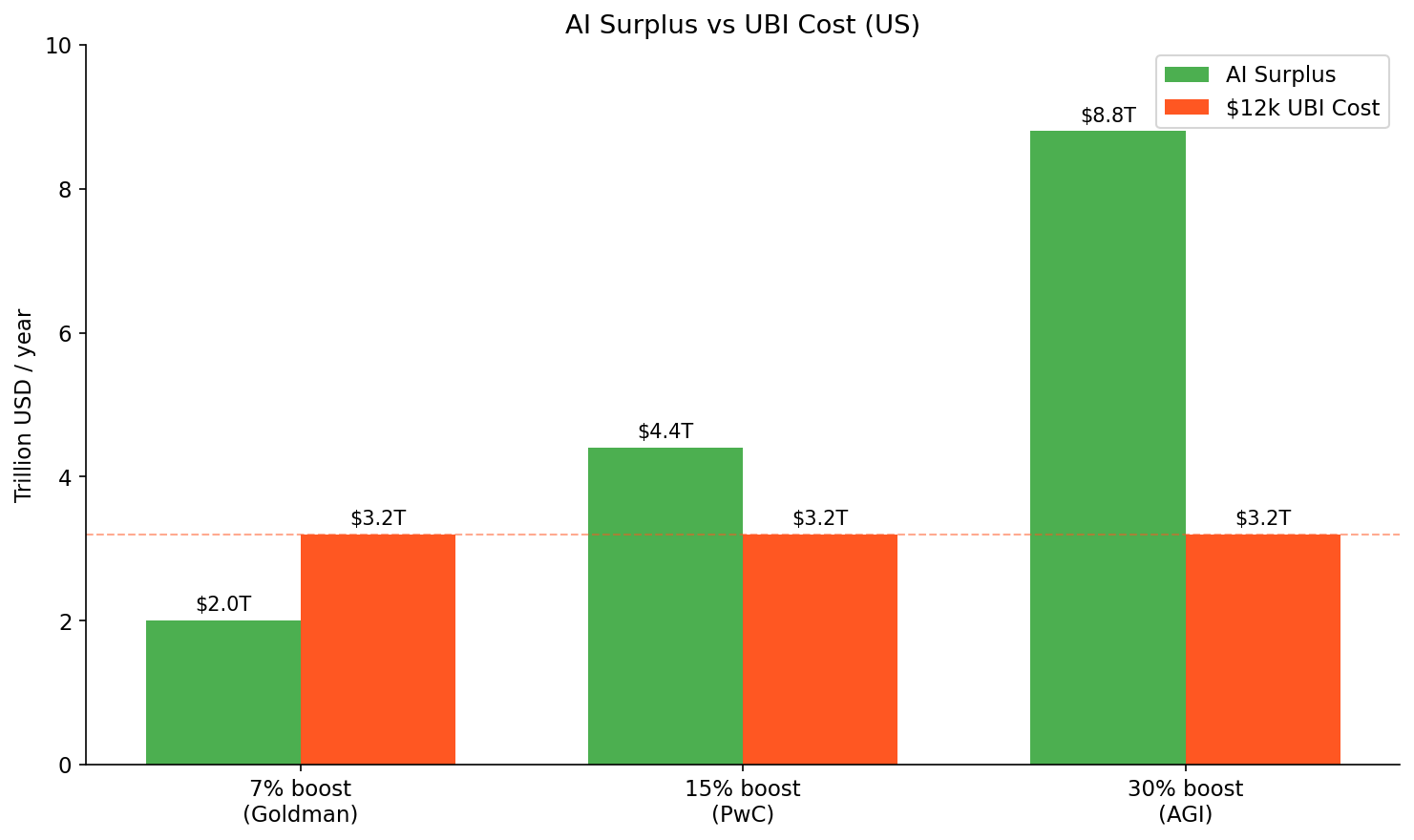
Now, a $12,000/year UBI for every American adult (that's $1,000/month) costs about $3.2 trillion per year gross. Which sounds like a lot until you notice it's less than the conservative AI productivity estimate. You could fund the entire thing just by taxing the new output and not touching anyone's current income. The math is almost suspiciously clean.
There's also a distinction most people miss: the net cost of UBI is way lower than the gross cost. Karl Widerquist did this calculation and found that with a 50% flat tax and some program consolidation, the net cost is around $540B/year. That's 3% of GDP. The reason is that most of the money just cycles through the system. Government sends you $12k, you pay $6k back in taxes, net transfer is $6k. The scary $3.2T number is mostly accounting fiction.
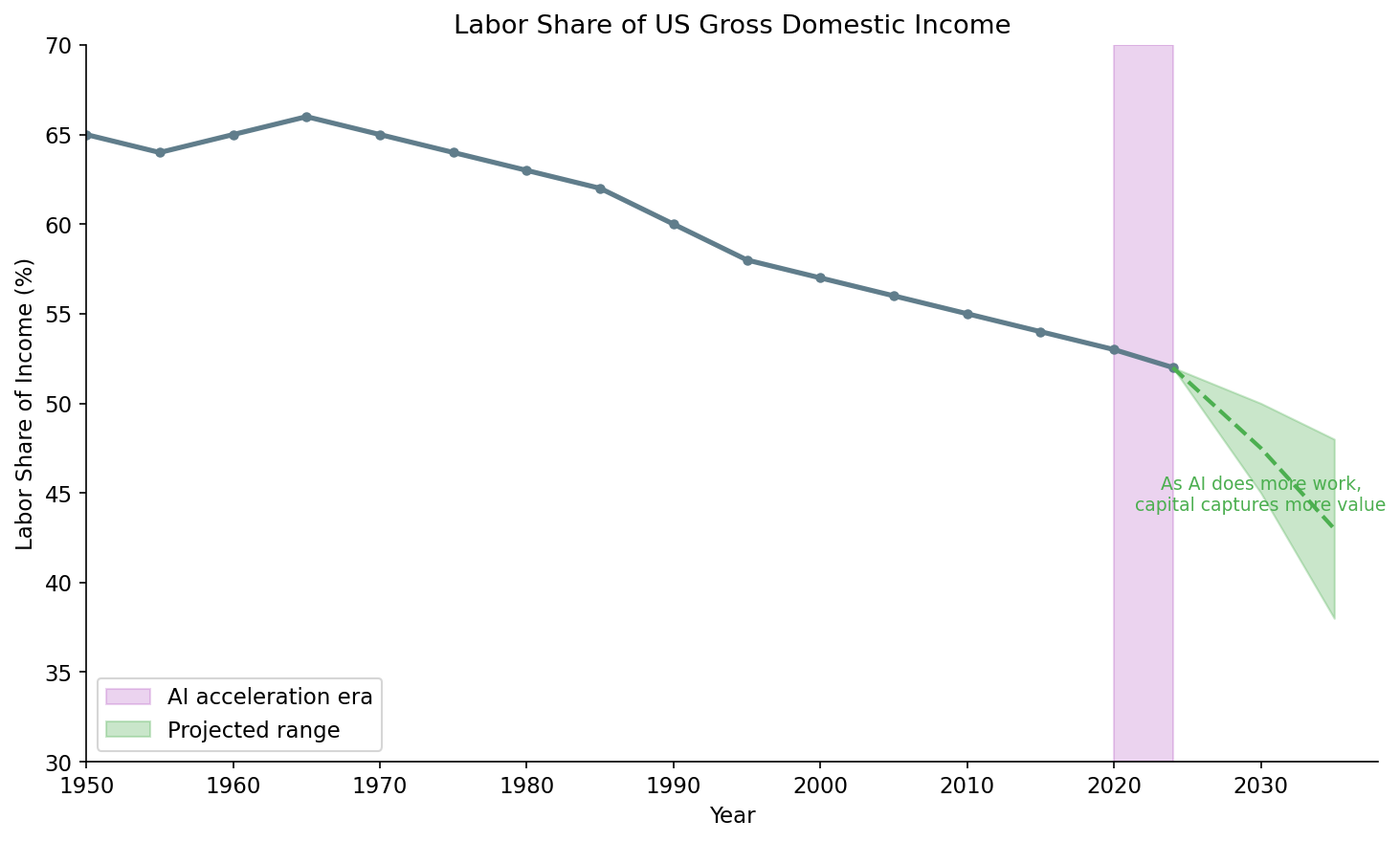
Where does the money actually pool in an automated economy? Right now wages are about 52% of US gross domestic income. As AI does more work, that shifts toward capital: corporate profits, rents, datacenter real estate, the value of model weights themselves. Corporate profits after tax are already over $3T/year and trending up. So the tax base shifts from "income from working" to "income from owning the things that work." You don't need new economic ideas for this, just different tax targets.
Alaska has been doing something like this since 1976 with oil. The Permanent Fund is worth $80B and pays out $1,700/year to every resident, funded entirely by investment returns. It's not crazy to imagine doing the same thing with AI compute and model IP. A global version of that could easily hit $10-15k/year per person. Every human on Earth as a shareholder in civilization's productive capacity.
Does UBI break work incentives? #
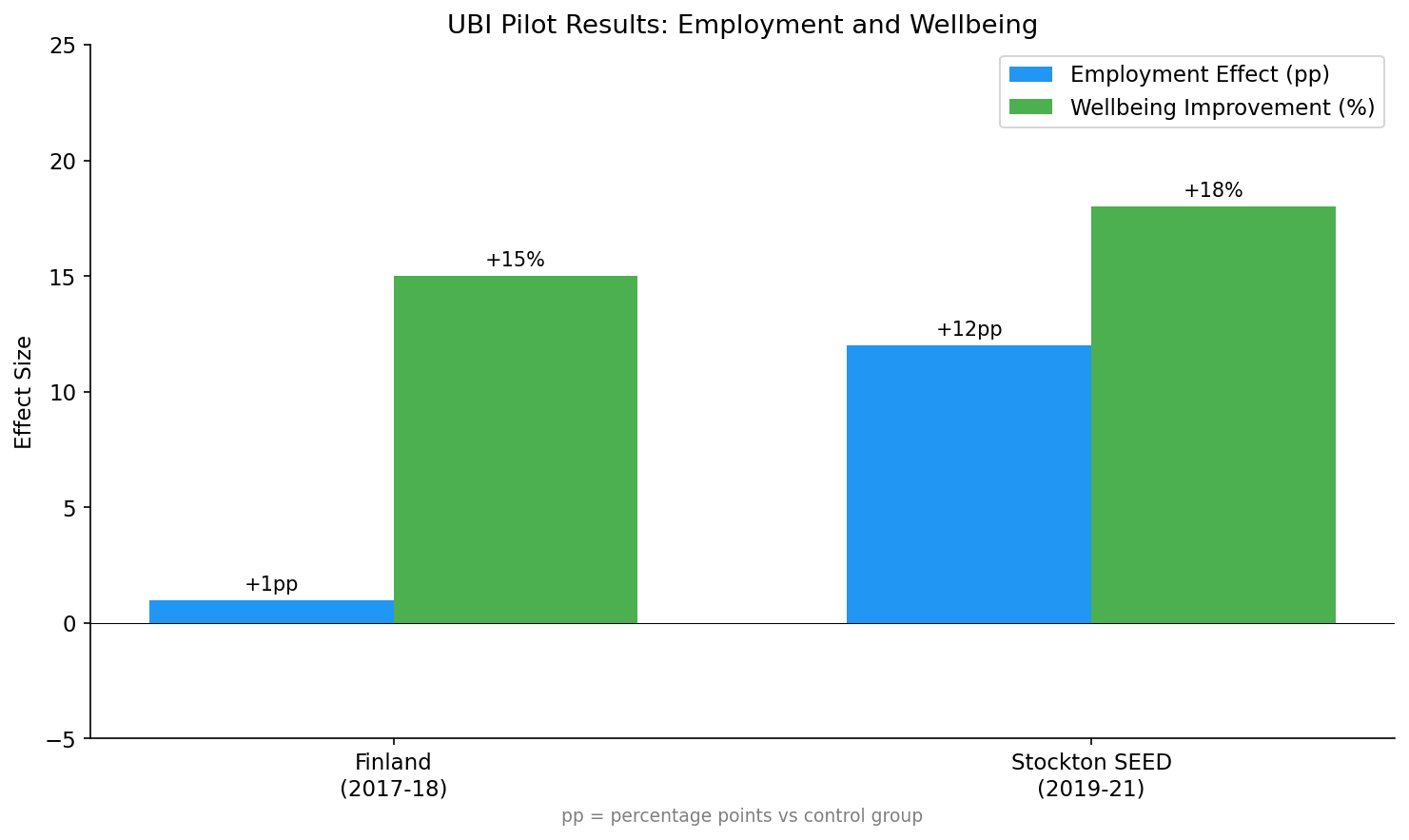
Everyone asks this and the answer is apparently no. Finland gave 560 euros/month to 2,000 unemployed people for two years. No drop in employment, significant improvements in mental health. Stockton gave $500/month to low-income residents and full-time employment actually increased by 12 percentage points versus controls. The pattern in pretty much every pilot is: people don't quit working, they quit working jobs they hate. They go back to school, start small businesses, take care of family members, or just stop doing degrading work they only tolerated because the alternative was homelessness.
The revealed preference when you give people a floor is not "lie around doing nothing" but "do the thing I actually wanted to do." The narrative about human laziness doesn't really show up in the data.
Beyond vanilla UBI #
Flat cash transfers are elegant but maybe not optimal. A negative income tax is mathematically the same as UBI + flat tax but only poor people receive checks, which is an easier political sell even though it's identical policy. Universal basic services (free healthcare, transit, housing, internet) might be more cost-effective because you're decommodifying the stuff that would eat most of a cash transfer anyway. My guess is some combination works best: free services for the things that are naturally monopolistic or have huge positive externalities, plus a modest cash floor for everything else.
The version I find most interesting is treating AI infrastructure as a collectively owned asset (Sam Altman has written about this). Every citizen holds a small equity stake in national compute and model IP. You get dividends in cash or services, and maybe some of your voting power over AI governance routes through these shares. It's structurally the same as the Alaska Permanent Fund but for the thing that's actually going to matter in 20 years. You'd end up with everyone having a genuine ownership stake in the system that feeds them, rather than being a passive recipient of transfers from a government that could always decide to stop.
So what actually happens? #
I don't know. If you made me bet, I'd say we probably end up with some janky patchwork of negative income tax, expanded public services, and maybe a compute dividend if we're lucky. The thing I'd want is that nobody's survival depends on having a job, people can spend time on weird projects or caring for family without slowly going broke, and the people who genuinely want to do math or build fusion reactors still have unlimited upside.
My dad wasn't making an economic argument when he said "make waffles." He was saying something about what human activity looks like when you're not coerced into working. Most of what people would do in that world isn't legible as "productive" by current standards. Making waffles for your neighbors, learning shamisen, spending three years on a weird math problem, being present for people you love. That kind of thing.